10 things you probably didn’t know about mosquito laboratories
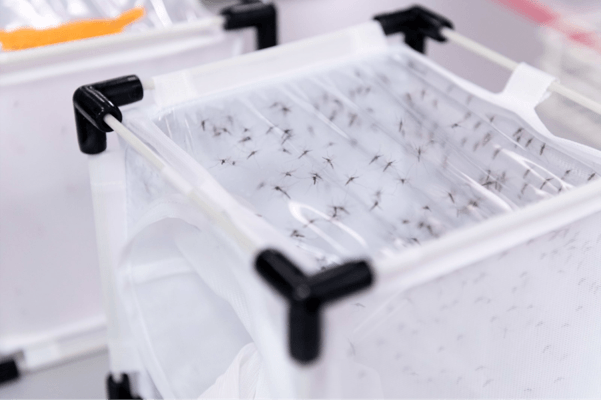

Most people know mosquitoes as the tiny insects responsible for biting them, making them itchy, and transmitting malaria. Few ever stop to think about the laboratories where scientists spend years studying them.
The profession of entomologist remains relatively unknown. Through the series ‘Entomology Explained’, Target Malaria has been raising awareness for several years about mosquitoes, their physiology and their role in the transmission of malaria.
This year, to mark World Mosquito Day, scientists at Target Malaria are offering you a fresh insight into life in the laboratory when conducting entomological research. Here are 10 things you didn’t know about the lives of laboratory mosquitoes.
- Mosquitoes have their own nurseries
Every mosquito begins life as an egg. In laboratories, scientists carefully collect eggs and place them in controlled environments where they hatch into larvae before developing into adults. Every stage of their life cycle is closely monitored to ensure healthy colonies for research.
- Scientists collect mosquito eggs by hand
Mosquito research requires remarkable precision. Researchers carefully collect tiny mosquito eggs before they are used in experiments. The process demands patience, skill, and steady hands because the eggs are incredibly delicate.
- Timing is everything
When developing genetically modified mosquitoes for research, scientists work against the clock. Microinjection must be completed within a narrow window after eggs are laid. Too early and the embryos are too fragile. Too late and they become too firm for the procedure to succeed.
- Mosquitoes are studied under powerful microscopes
Many laboratory procedures happen under high-powered microscopes. Scientists use specialised equipment to examine mosquito embryos, larvae and adults, allowing them to observe details invisible to the naked eye.
- Some mosquitoes glow under special light
One of the most fascinating parts of mosquito research happens after successful genetic modification.
Scientists include a fluorescent marker within the genetic material. When illuminated under a specialised microscope, successfully modified mosquito larvae glow, allowing researchers to identify them quickly and accurately.
- Most mosquito embryos never make it
Developing genetically modified mosquitoes is a highly specialised process. Many embryos do not survive the delicate injection procedure, which is why scientists continually refine their techniques to improve success rates while maintaining rigorous laboratory standards.
- Temperature can determine whether a colony survives
Mosquitoes are surprisingly sensitive to their surroundings. Laboratories carefully regulate temperature, humidity, and light cycles to create stable conditions that allow mosquito colonies to develop normally. Even small environmental changes can affect their survival and behaviour.
- Some mosquito colonies have been maintained for years
Scientific research does not happen overnight. Certain mosquito colonies are maintained across multiple generations, allowing scientists to study long-term biological characteristics and evaluate potential innovations over time.
- One mosquito can produce hundreds of eggs
A single female mosquito can lay hundreds of eggs during her lifetime. Understanding mosquito reproduction is fundamental to malaria research because it helps scientists investigate how mosquito populations respond to different interventions.
- Every laboratory discovery begins with understanding the mosquito
Before any potential malaria innovation can be considered, scientists must first understand the insect itself. From studying mosquito biology and behaviour to evaluating new approaches under carefully controlled laboratory conditions, every step is guided by evidence, rigorous testing, and responsible scientific practice.
As researchers continue exploring complementary tools to help reduce malaria transmission, laboratory research remains the essential first step in understanding whether new approaches are safe and appropriate for further study.
“For those curious to experience this work first-hand, Target Malaria: The Game is now available as a free mobile app for both iOS and Android, as well as on desktop. Players can step into the role of a molecular biologist, using the same principles employed in real laboratories to perform microinjections and identify genetically modified mosquito larvae through transgenic screening. The game was developed to make complex science more accessible while inspiringgreater understanding of malaria research,” says Dr Simoni.
He adds that players can also go behind the scenes inside a mosquito laboratory to see the expertise and care involved in conducting this research.