Social media and communications toolkit
World Malaria Day
25 April 2026
Together, we can end malaria!
Driven to end malaria: Now we can. Now we must.
Every year, malaria kills over 610,000 people and infects over 282 million people; a third of the world is at risk of contracting this disease transmitted by mosquitoes. Many of the victims are children under the age of five living in Africa.
According to the World Malaria Report 2024 published by the World Health Organisation, despite tremendous progress in reducing malaria around the world, since 2015 this progress has slowed, hitting a plateau in the last three years. The WHO warns that the global response to malaria has reached a “crossroads”: if investment is not raised and new tools are not found, key targets of WHO’s global malaria strategy will likely be missed.
This World Malaria Day:
Grasp the moment.
Protect lives now.
Fund a malaria-free future.
Zero Malaria Starts With Me.
#WorldMalariaDay #EndMalaria #ZeroMalaria #ZeroMalariaStartsWithMe #NowWeCanNowWeMust
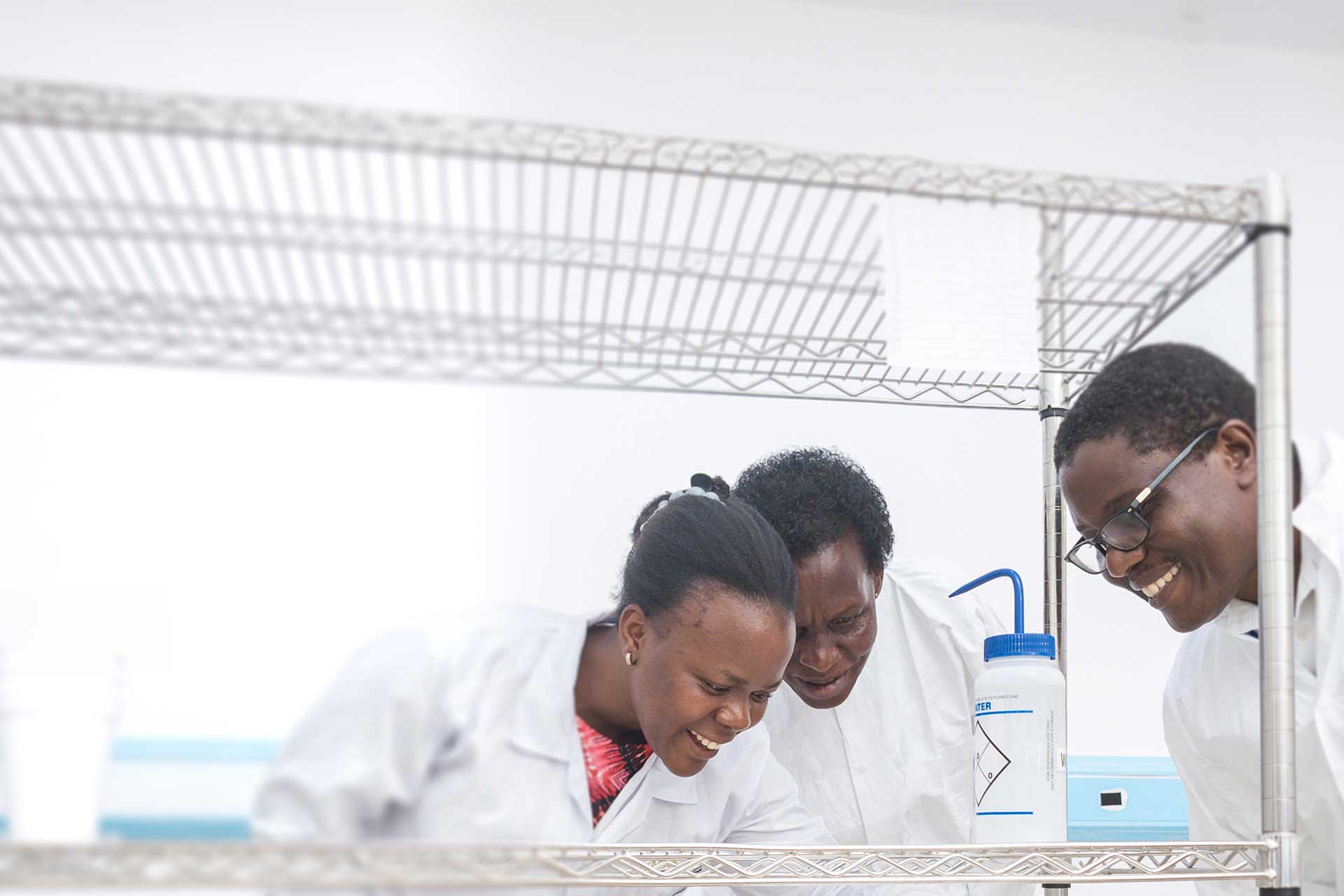


The need for new tools to fight malaria
Africa’s malaria response is under growing pressure from a convergence of threats that are disrupting essential life-saving services, stretching already thin health systems, and increasing the risk of resurgence. These overlapping threats are making it harder to maintain progress and increasing the urgency to act quickly and at scale. If not addressed, they threaten to reverse over a decade of gains.
The WHO has noted that current interventions will not be enough to reach elimination targets. Investment in malaria research to develop new tools is needed. Innovations, such as second-generation vaccines, dual-insecticide repellents and genetically modified mosquitoes, hold the promise to complement existing interventions.
Gene drive video series
For World Malaria Day, malaria researchers are opening their labs to demystify the research that is carried out and to educate the public on the importance of investing in malaria research.
One of the important areas of malaria research is the potential future role of genetically modified mosquitoes and gene drive mosquitoes in complementing existing malaria interventions. With proper governance and transparency, these tools could provide sustainable options for reducing transmission in high-burden settings where current methods are no longer sufficient.
The series is made up of 4 videos that will be released through the year. They explain how to develop gene drive mosquitoes in secured labs.
Gene drive video series – Part 1
Why are we developing gene drive mosquitoes to control malaria in Africa?
Video capsules
Innovate to eliminate
Despite being preventable and treatable, malaria remains deadly and progress is stalling, which means new tools are needed.
#WorldMalariaDay #EndMalaria #ZeroMalaria #ZeroMalariaStartsWithMe #NowWeCanNowWeMust
Driving genes
Gene drive increases the chance of inheritance so a chosen genetic trait spreads through a mosquito population.
#WorldMalariaDay #EndMalaria #ZeroMalaria #ZeroMalariaStartsWithMe #NowWeCanNowWeMust
The malaria toolbox
Gene drive could complement bed nets, insecticides, and vaccines; investment in research needs to be increased.
#WorldMalariaDay #EndMalaria #ZeroMalaria #ZeroMalariaStartsWithMe #NowWeCanNowWeMust
All assets have been developed in several languages and are available for download.
Social media sample posts
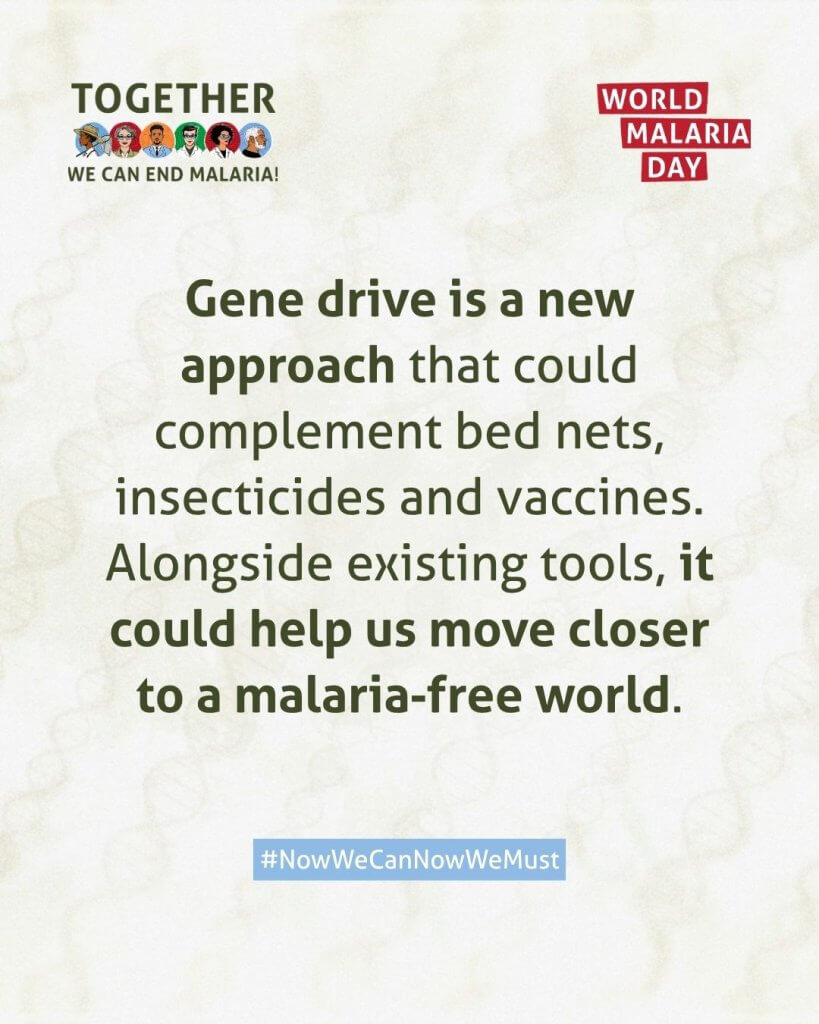
An important area of #Malaria research is the potential future role of genetically modified mosquitoes and #GeneDrive mosquitoes in complementing existing malaria interventions. Together with proper governance and transparency, we can #EndMalaria!
#WorldMalariaDay #EndMalaria #ZeroMalaria #ZeroMalariaStartsWithMe #NowWeCanNowWeMust
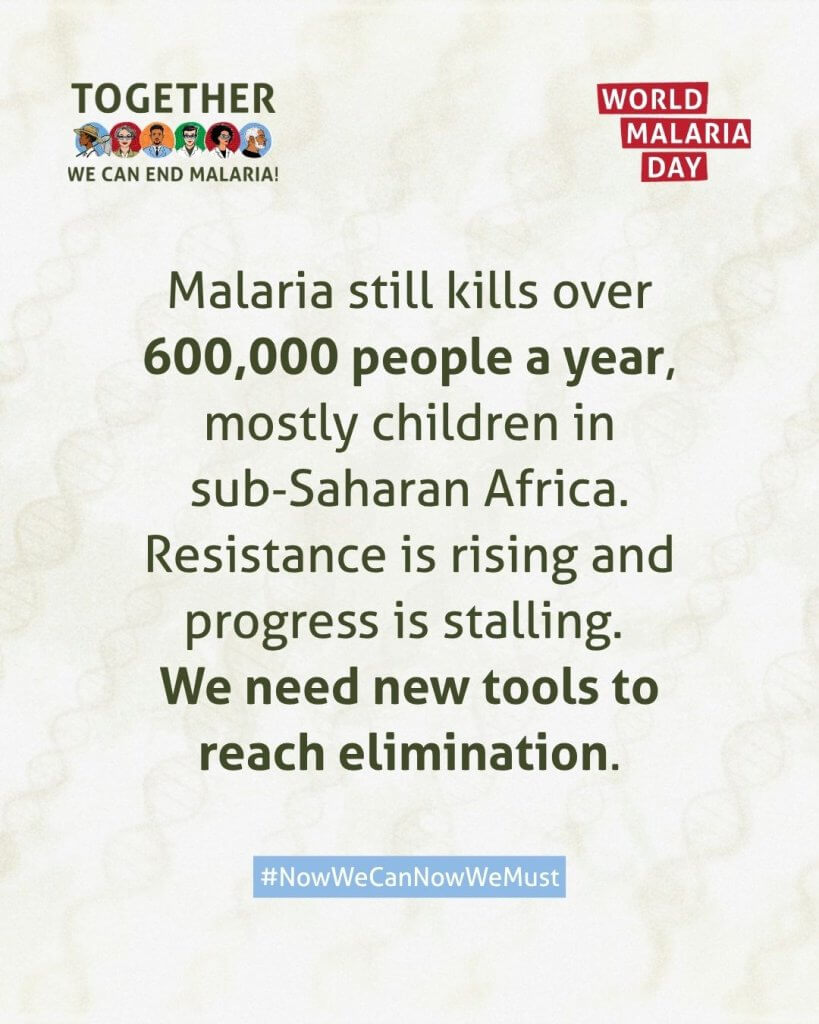
Every year, #Malaria kills over 600,000 people and infects over 282 million people, many of the victims are children under the age of five living in Africa. We urgently need new tools to help #EndMalaria!
#WorldMalariaDay #EndMalaria #ZeroMalaria #ZeroMalariaStartsWithMe #NowWeCanNowWeMust
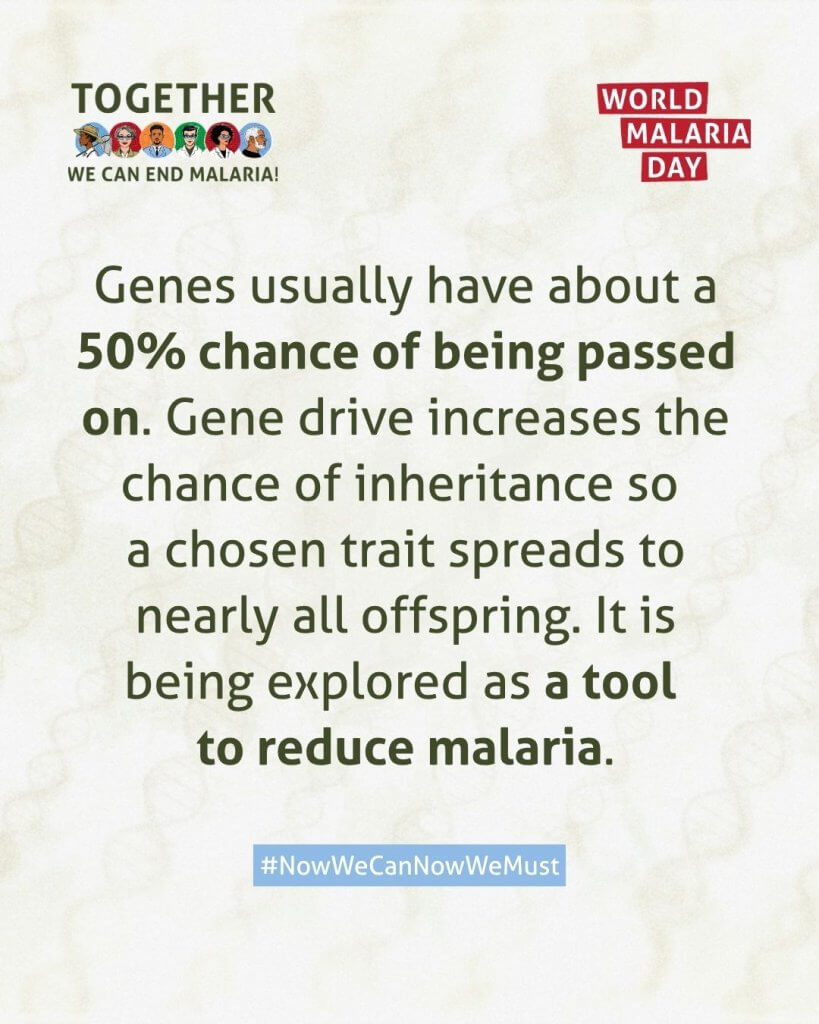
#DidYouKnow that #GeneDrive increases the chance of inheritance so a chosen genetic trait spreads through a mosquito population. Gene drive is a new approach which could complement existing #Malaria control tools. Together we can #EndMalaria!
#WorldMalariaDay #EndMalaria #ZeroMalaria #ZeroMalariaStartsWithMe #NowWeCanNowWeMust
“Our approach has spanned the full spectrum of what it takes to beat this disease. Tanzania has invested in world-class research where our scientists are working at the frontier of new technologies. One of them is gene drive, an innovative approach that aims to ensure mosquitoes can no longer transmit the malaria parasite. This is African science, conducted by African researchers, addressing an African challenge.”
H.E. Samia Suluhu Hassan, President of the United Republic of Tanzania
Key messages