Target Malaria publishes new research detailing Sex Distorter Male Drive technology for malaria vector control

A new article published in Nature Communications introduces a novel genetic tool, the Sex Distorter Male Drive, which is predicted to be more resilient to the emergence of resistance than previous approaches, making it a promising option for malaria vector control. The paper examines the feasibility of using genetic transmission mechanisms to shift the sex ratio in favor of male mosquitoes, as well as ways to limit the emergence of resistance to this vector control tool.
Genetic vector control is being explored to complement existing interventions to accelerate progress toward malaria elimination. One approach aims to reduce the target Anopheles mosquito population to an extent where disease transmission can no longer be sustained. For instance, a genetic modification can be designed to disrupt a female-fertility gene and make females carrying two disrupted copies sterile. Females with one disrupted copy remain fertile, and males are fertile with either one or two disrupted copies..
To achieve the desired suppression effect, this trait must spread in the target mosquito population. However, under normal Mendelian inheritance such modification is passed to only half of the offspring and would be gradually lost over generations. Gene drive technologies overcome this limitation by biasing inheritance so that most of the progeny inherits the desired modification. As the trait spreads, more females inherit two disrupted copies of the gene, making them sterile and potentially leading to population suppression.
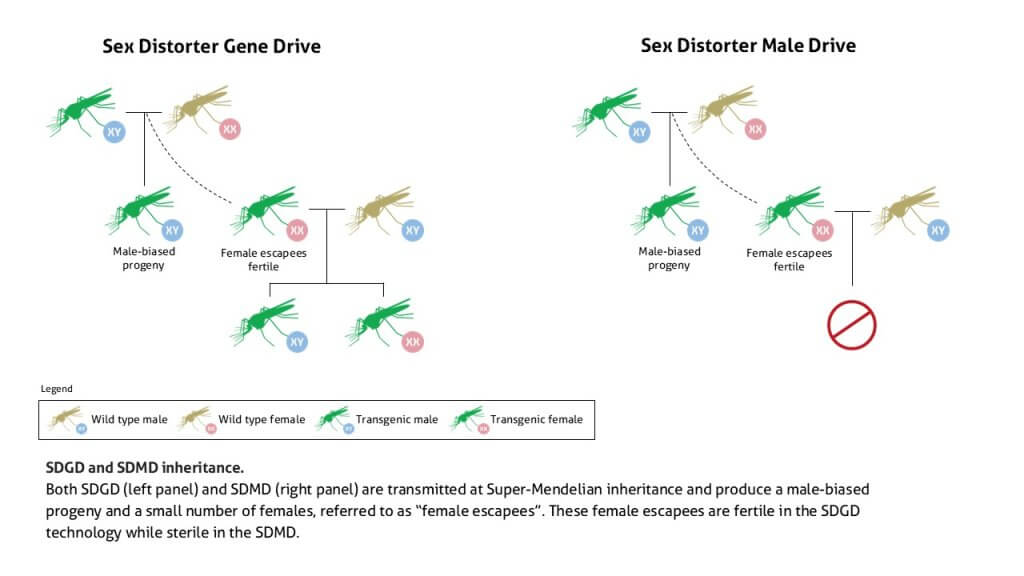
An X-shredding sex distorter component can also be incorporated in this gene drive system, a technology known as Sex Distorter Gene Drive (SDGD). In this approach, the X chromosome is selectively damaged during spermatogenesis such that most functional sperms carry the Y chromosome. Because Anopheles males possess one X and one Y chromosome whereas females two X chromosomes, the resulting progeny is ultimately biased toward males. By reducing the number of female mosquitoes in each generation, the SDGD offers two main advantages. First, because only females bite humans, this system directly reduces the number of vectors capable of transmitting the malaria parasite. Second, SDGDs are expected to be more resilient to resistance, a major challenges for gene drive technologies.
Resistance arises when genetic variants at the gene drive target site prevent the intended disruption. Because the gene drive’s target is a female-fertility gene, selection for resistance occurs primarily in females: any resistant variant that restores female fertility could be favoured and spread through the population, reducing the effectiveness of the intervention. Consequently, by biasing the sex ratio toward males, SDGD reduces the opportunity for the selection of resistance.
Could we further enhance the resilience of SDGD systems to resistance?
In our latest study titled “Sex distorter male drive for resistance-resilient population control of the human malaria vector Anopheles gambiae“, published in Nature Communications, we describe a new approach that simplifies previous SDGD designs and further reduces the likelihood of selection for resistance by ensuring the sterility of the rare female escapees.
The SDMD construct is inherited at super-Mendelian inheritance and can increase in frequency over generations. Like previous SDGDs, the mosquitoes’ X chromosome is damaged during spermatogenesis, resulting in a male-biased progeny. The key difference from previous SDGD systems is that the few females produced in the SDMD are fully sterile.
This feature has crucial implications for resistance management: even if resistant variants arise in these females, they cannot be passed to future generations because the females are unable to reproduce, making the SDMD more resilient to resistance than gene drive or SDGD systems.
Another advantage of our newly developed SDMD is its simplicity. Earlier SDGD designs required multiple promoters and nucleases because gene drive and sex distortion rely on molecular processes that occur at different stages of mosquito gametogenesis. In our study, we characterized two germline promoters capable of driving nuclease expression at a timing suitable for both gene drive and sex distortion, a unique feature among the promoters identified so far. By leveraging these unique features, our SDMD technology was developed with minimal genetic components compared to previous SDGD systems.
What SDMD could mean for malaria control
Mathematical modelling suggests that the SDMD strategies could be promising for controlling Anopheles gambiae mosquitoes’ population, offering greater resilience to resistance and longer-lasting population suppression effect.
The SDMD strain developed in this study represents a proof-of-principle design developed and tested in our lab, and no field releases are planned. While extensive risk assessment, regulatory review, and community agreement would be required before any future field evaluation, our findings suggest that SDMD could become a valuable addition to the growing toolbox of genetic technologies for malaria control to support the long-term goal of a world free from malaria.