Africa’s malaria fight needs the private sector

During Africa month, global leaders will gather at high-level platforms like the Africa CEO Forum and the World Health Assembly to discuss the continent’s economic future. Yet one of the most persistent barriers to that future remains underfunded – malaria.
Despite decades of progress, malaria continues to place a heavy burden on African economies, health systems and families. It is a disease that disproportionately affects the most vulnerable, especially women and children, and quietly undermines productivity, education and long-term development.
New research led by researcher Paul Bangirana of Makerere University and Chandy John of Indiana University, show that children who suffered cerebral malaria or severe malaria‑induced anemia score lower on cognitive and math tests years later. The findings signal a stark reality: malaria is not only claiming young lives today but also jeopardising future generations’ ability to solve Africa’s toughest challenges.
“Malaria is not only claiming young lives today but also jeopardising future generations’ ability to solve Africa’s toughest challenges.”
Krystal Birungi, Entomologist and malaria advocate at Target Malaria
Ending malaria is an economic imperative.
For years, the fight against malaria has relied heavily on public and donor funding. Institutions such as The Global Fund have played a critical role in saving lives and scaling interventions. But as global priorities shift and funding gaps widen, it is becoming increasingly clear that public financing alone will not be enough to achieve elimination.
This is where the private sector can step in as a central player. Private capital has transformed industries across Africa, from fintech to renewable energy. It has demonstrated an ability to scale innovation, drive efficiency and unlock new markets. Yet in global health, and malaria in particular, private sector engagement has remained limited.
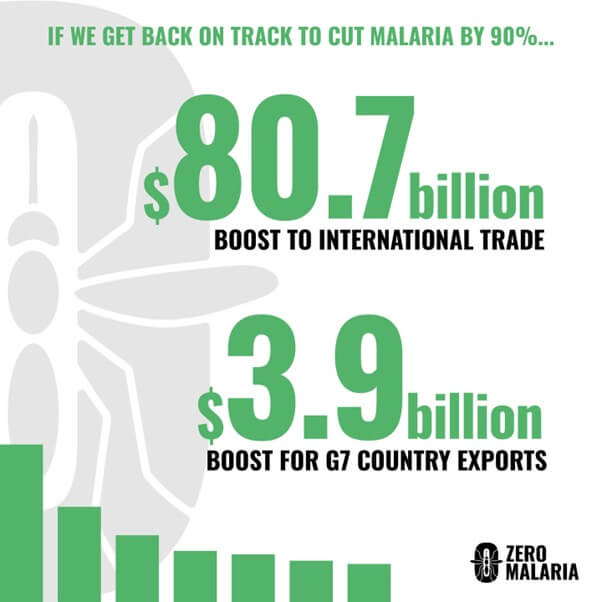
I believe this is a missed opportunity because malaria is not just a health issue, it is a business issue. It affects workforce productivity, supply chains and economic stability. For companies operating in or investing in Africa, malaria translates into lost working days, increased healthcare costs and reduced economic output. Investing in malaria prevention and innovation is therefore not only socially responsible, but also economically rational.
More importantly, the nature of the malaria challenge is evolving. Mosquito resistance to existing insecticides is rising, and while tools such as bed nets, diagnostics and vaccines remain essential, they will not be sufficient on their own. New approaches are needed to complement existing interventions and sustain progress.
Investment in scientific innovation
Emerging technologies, such as genetic approaches to mosquito control, are being researched as tools to reduce malaria transmission. These innovations require long-term, patient investment, not only in research and development, but also in regulatory systems, community engagement, and capacity building. Ecosystems that nurture creativity, collaboration, and the rise of future pioneers in healthcare and biotechnology are urgently needed to support young African researchers.
This is precisely the kind of complex, high-impact challenge where private capital can play a catalytic role.
However, unlocking this potential requires a shift in mindset.
First, malaria must be reframed as an investment opportunity, not just a development challenge. This means identifying clear pathways for private sector participation, from funding research partnerships to supporting local manufacturing and health infrastructure.
Second, collaboration models must evolve. Public-private partnerships can de-risk investment and align incentives, ensuring that innovation is both impactful and scalable. African institutions and scientists must be at the centre of these partnerships, shaping solutions that are locally relevant and globally significant.
Third, trust and accountability must remain foundational. In areas such as genetic technologies, engagement with communities and transparent governance are essential. Private sector involvement must strengthen, not undermine, these principles.
Signs of progress
African scientists, entrepreneurs, and institutions are increasingly leading research and innovation efforts on the continent. This shift is not only about ownership, but effectiveness too. Solutions that are developed with local expertise and grounded in community realities are more likely to succeed.
“The private sector has both the resources and the incentive to contribute meaningfully to malaria elimination.”
Krystal Birungi, Entomologist and malaria advocate at Target Malaria
As African and world leaders convene this month, there is an opportunity to elevate malaria financing as a strategic priority. The conversation must move beyond commitments to concrete mechanisms that bring in new actors and new capital.
The private sector has both the resources and the incentive to contribute meaningfully to malaria elimination. What is needed now is the urgency to act.
Ending malaria in Africa is within reach, but only if we expand the circle of responsibility. Governments, donors, scientists and communities all have a role to play. So too does the private sector.
The question is no longer whether we can afford to invest more in malaria. It is whether we can afford not to.
This op-ed was first published on New African Magazine.