A new mosquito embryo sexing system reveals potential targets for malaria control

How do male and female mosquitoes develop so differently when they share nearly identical genomes?
This is one of the most interesting questions in biology. In many animals, such as mammals and the malaria mosquito Anopheles gambiae, the main genetic difference between the sexes is in the sex chromosomes: males are XY and females are XX. Even so, this small difference leads to major developmental differences between the sexes.
In Anopheles gambiae, these differences are striking and they matter. Female mosquitoes bite and take blood meals, which they need to develop eggs. While feeding, they can also transmit the malaria parasite. On the contrary, males do not bite and feed mainly on nectar. Because only females spread malaria, understanding how sex is determined in this species is important not only for basic biology, but also for developing new ways to control mosquitoes population and reduce malaria transmission.
A system to separate male and female embryos
One challenge in studying mosquito sex determination is that embryos are all identical and unlike adults, you cannot tell whether an embryo is male or female just by looking at it. Scientists can genotype embryos one by one, but this process can be challenging and provides only small amounts of sex-specific material for experiments such as RNA sequencing.
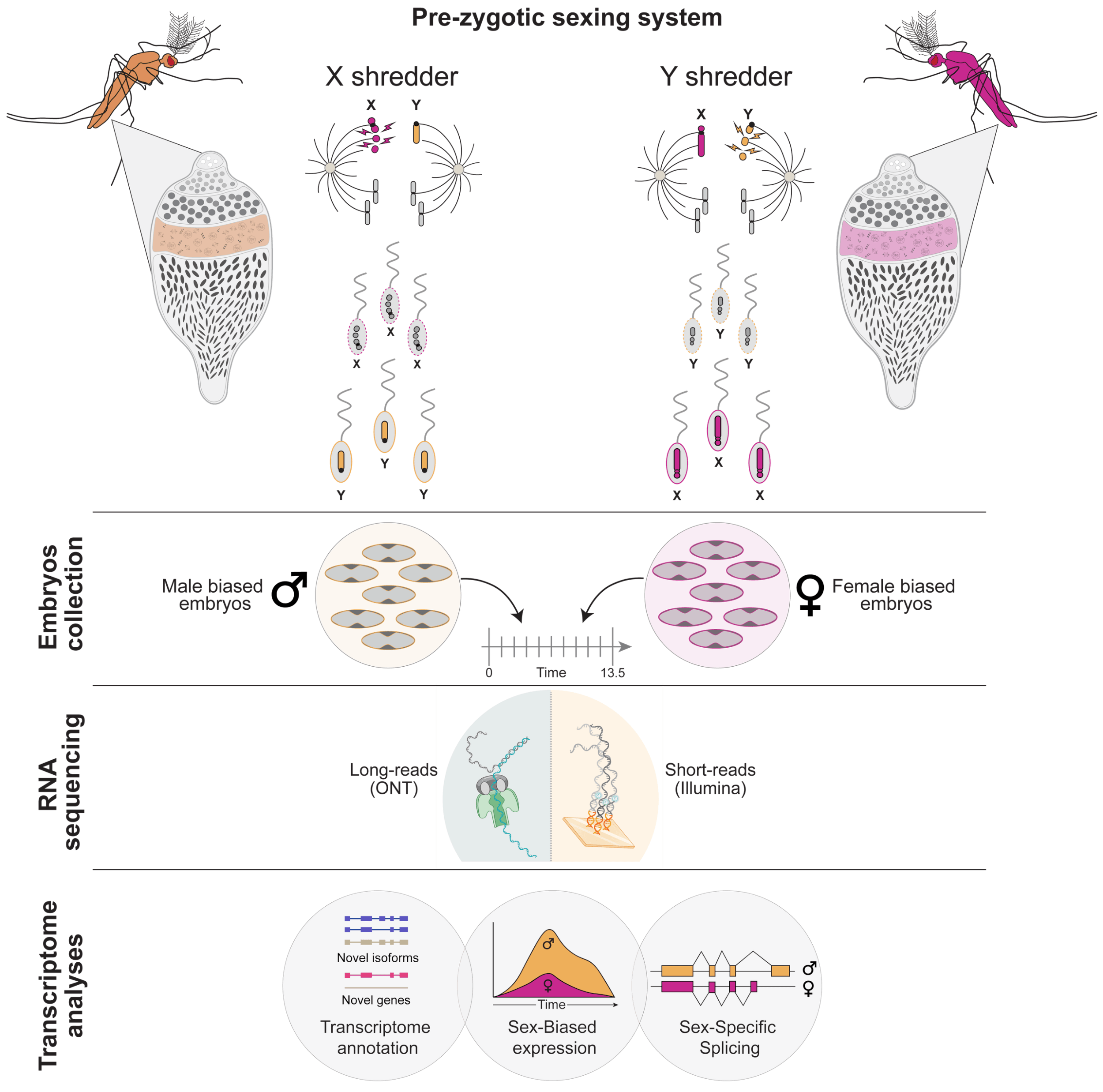
To solve this problem, we used two genetically engineered mosquito strains that distort the sex ratio of their offspring. One strain produces almost all-female progeny, while another, known as an X-shredder, produces mostly males. By combining these sexing strains, we created a “pre-zygotic sexing” system that generates large batches of embryos that are strongly male-biased or female-biased. This means we can study sex differences in early embryos without having to identify the sex of each embryo individually.
This system made it possible to investigate sex differences during early stages of mosquito development, when sex is first being established.
How sex is determined in mosquito embryos
In mosquitoes, sex is controlled by a small number of early-acting genes, often called pioneering factors. These genes start a developmental cascade that pushes the embryo toward either male or female development.
A key feature of this pathway is alternative splicing. This is the process by which a single gene can produce different RNA transcripts, called isoforms, which can then give rise to different protein versions. In the insect sex-determination pathway, many genes produce one isoform in males and another in females. These different isoforms help direct sex-specific development.
One of the best-known examples is Doublesex (Dsx), a gene found across many insects. In Anopheles gambiae, Dsx is spliced differently in males and females, producing male- and female-specific protein forms. These play a central role in creating the morphological and developmental differences between the sexes.
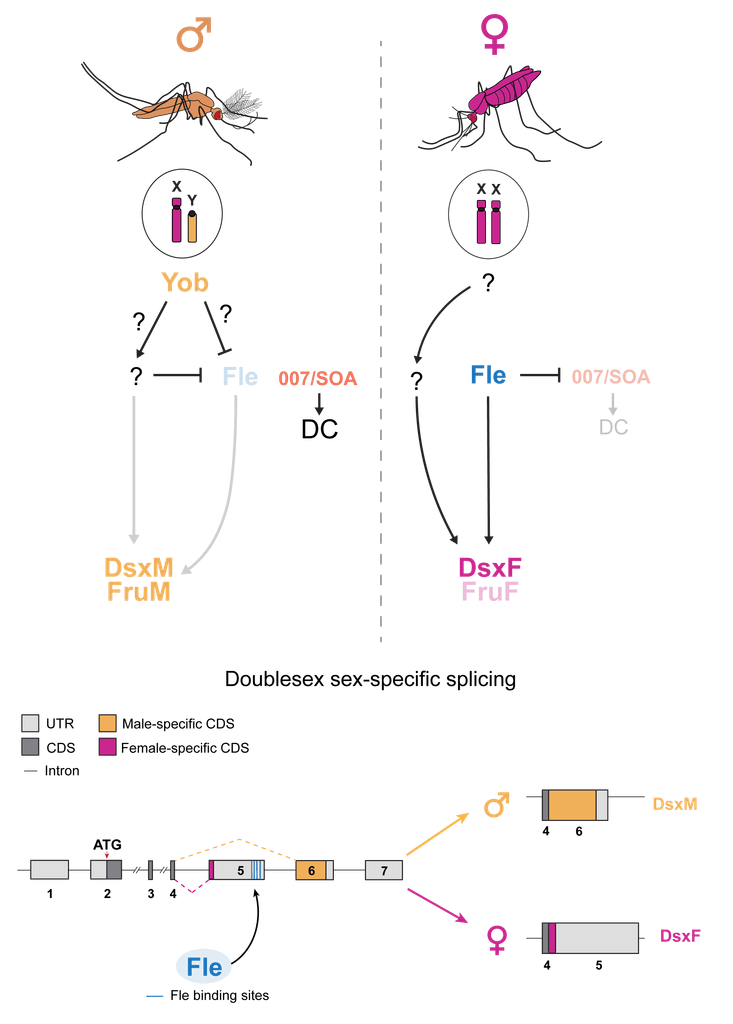
In male Anopheles embryos, the Y-linked gene Yob is expressed very early, around three hours after fertilization. Yob represses Femaleless (Fle), an RNA-binding protein that normally promotes female-specific splicing. When Fle is repressed, male-specific splicing is established in downstream genes such as Dsx and Fruitless (Fru), helping drive male development. In females, Fle remains active and promotes female-specific splicing, establishing the female developmental pathway (Figure 1).
Why this matters for malaria control
Understanding this pathway is important because disrupting a gene involved in female development could stop females from biting or reproducing, while leaving males unaffected.
Previous work has already shown this with Dsx. When the female-specific form of this gene is disrupted, females fail to develop normally and cannot bite or reproduce.
This makes sex-determination genes promising targets for genetic control strategies, including population suppression approaches designed to reduce mosquito numbers and malaria transmission.
However, two big problems remain. First, the full network of genes involved in sex determination in Anopheles gambiae is still not known. Although some major genes have been identified, others are likely to play important roles. Second, early embryos are very difficult to study because the sexes cannot be easily separated. Our new sexing system can help solve this practical problem (Figure 2).
What our new study found
In our recent study, published in Cell Reports, we used this embryo sexing system to investigate early sex differences in Anopheles gambiae. We collected RNA from male-biased and female-biased embryo pools across early and late stages of development.
To capture the full complexity of gene expression, we combined long-read and short-read RNA sequencing. Long-read sequencing helped us discover new transcript isoforms, while short-read sequencing allowed us to measure how much of each isoform was present.
Using this approach, we identified around 3,800 new transcript isoforms expressed during early development. To find those most likely to be involved in sex determination, we focused on isoforms that were spliced differently in male and female embryos.
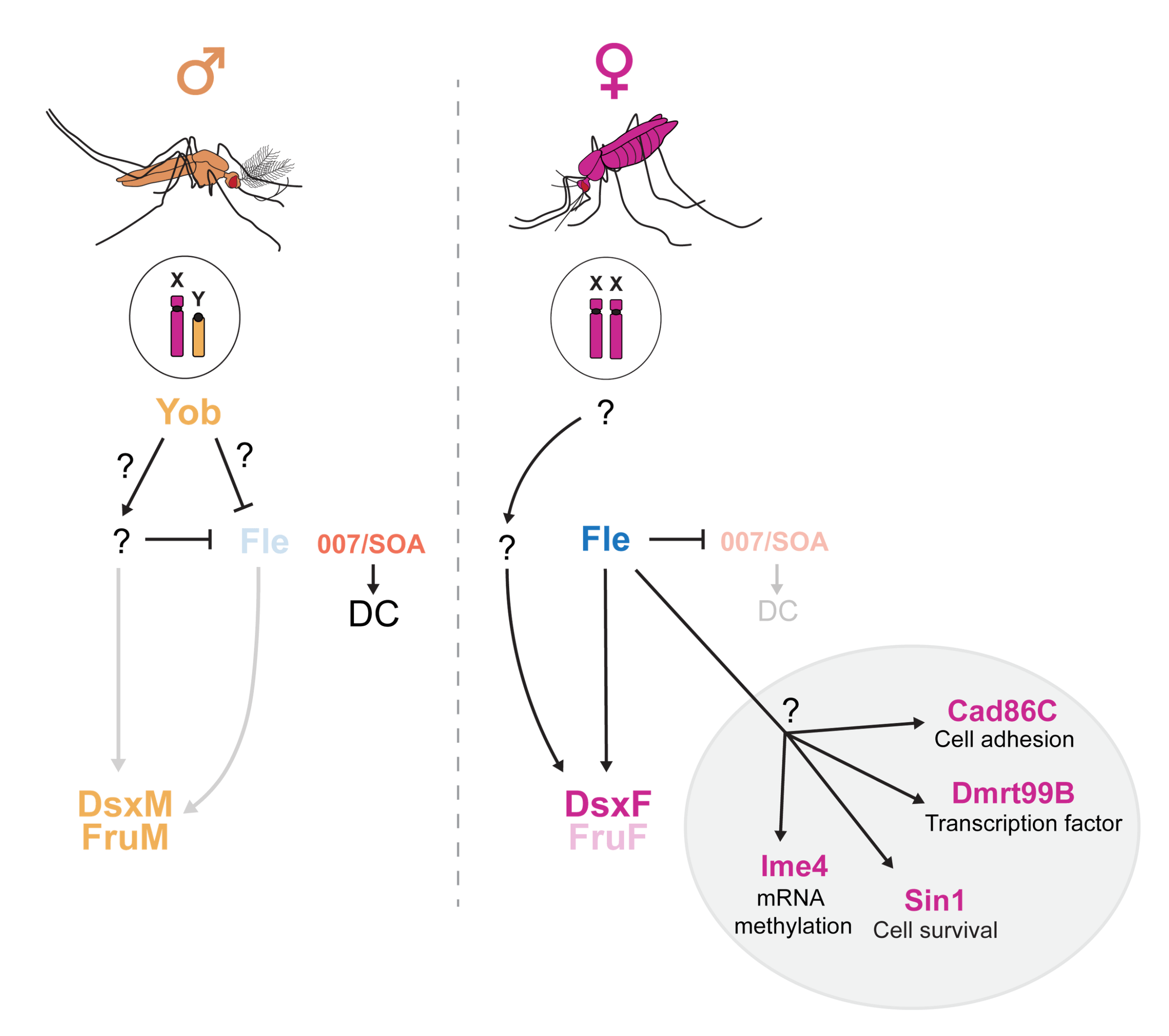
This led us to identify four new genes with sex-specific splicing patterns. We then tested their connection to the known sex-determination pathway and found that their splicing is regulated by Femaleless, the same protein that controls splicing of other key sex-determination genes such as Dsx, Fru and SOA.
These four genes are predicted to have roles in metabolism, mRNA methylation, cell adhesion and neuronal development. Because female-specific disruption of a single gene like Dsx can strongly affect female development, these newly identified genes may also become useful targets for mosquito control. We are now testing this with CRISPR/Cas9 experiments (Figure 3).
Conclusion
This study shows that our new embryo sexing system is a powerful way to study early sex-specific development in malaria mosquitoes. It also expands our understanding of the mosquito sex-determination network by identifying new genes that may be important for female development.
What began as a tool for biasing mosquito sex ratios has now become a valuable research method for discovering new targets for malaria control. By learning more about how female mosquitoes develop, we may be able to design more precise genetic strategies to reduce the number of malaria-transmitting mosquitoes.
